

Fire doors: what has to be right
A fire door only protects people if it is fitted exactly as its certificate says and kept closed, so it should be fitted by an experienced carpenter or joiner, to BS 8214 and the instructions that come with the door.
What the certificate controls, and why it matters
- Gaps. Keep every gap at 3 mm: at the sides, at the top and under the door. That meets the limit for smoke-rated doors (such as FD30S) as well as fire-only doors. If the door needs more room underneath to clear a carpet or other floor covering, fit a drop-down smoke seal or a threshold seal rather than leaving a bigger gap. Your own door's certificate and fitting instructions always come first, so if you're not sure, ask us before you trim.
- Trimming. Doors can only be trimmed by a small amount, keeping a minimum thickness of edge lipping. Never trim the edge that carries the fire certificate label or plug.
- Keep the ID label. The certification label or plug on the door, usually on the top or hanging edge, is how anyone can prove it is a certified fire door. Never remove it, cut it off, paint over it or hide it under a hinge or seal. Without it, a fire door inspector or fire risk assessor may treat the door as unproven and fail it, and the door may have to be replaced.
- Seals. Intumescent seals in the frame or door edge swell in a fire to close the gap. They must be the type and size in the certificate, fitted unbroken all round.
- Hardware. Hinges, locks, latches and closers must be suitable for fire doors, usually with at least three hinges.
- Glass. Only fire-rated glass and glazing systems named in the certificate, fitted by the method it gives.
- Self-closing. Most fire doors need a closer that shuts the door fully from any angle and engages the latch.
- Signs. Fire doors in shared areas carry "Fire door keep shut" (or "keep locked" for cupboards) signs on both faces.
The five-step check anyone can do
From the national Fire Door Safety Week campaign:
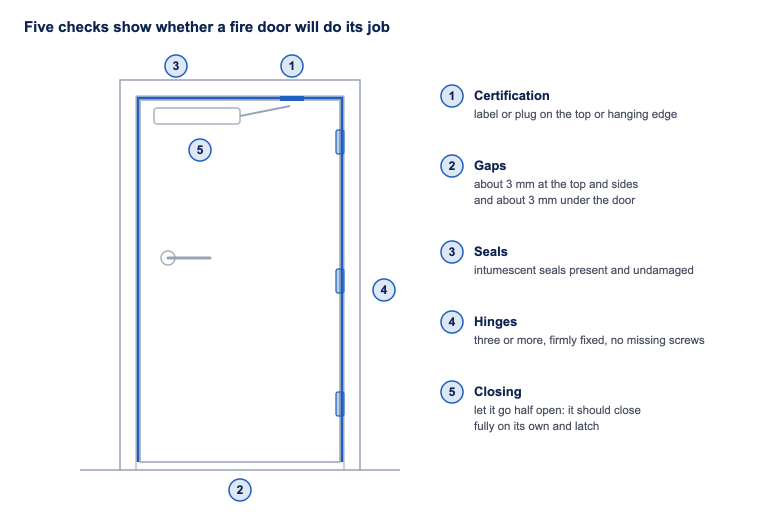
- Certification: look for a label or plug on the top or hanging edge.
- Gaps: about 3 mm at the top, the sides and under the door when it is closed. Light showing under the door usually means the gap is too big.
- Seals: intumescent seals present and undamaged.
- Hinges: three or more, firmly fixed, no missing screws.
- Closing: open it halfway and let go. It should close fully on its own and latch, without sticking.
For landlords and managing agents
In England, buildings with two or more flats and shared areas must give residents fire door information. Where the building has storeys over 11 metres, communal fire doors must be checked every three months and flat entrance doors every year, on a best-endeavours basis. See the GOV.UK fire doors fact sheet.
We supply certified FD30 and FD60 fire doors and complete doorsets, with the certificates for every door. Door-R-View Commercial builds the door schedule for a whole building.